Innovation in Nuclear Medicine and Nanomedicine (INMN 2026)
Aula Magna
Universidad Favaloro
CUIA Workshop on Innovation in Nuclear Medicine and Nanomedicine
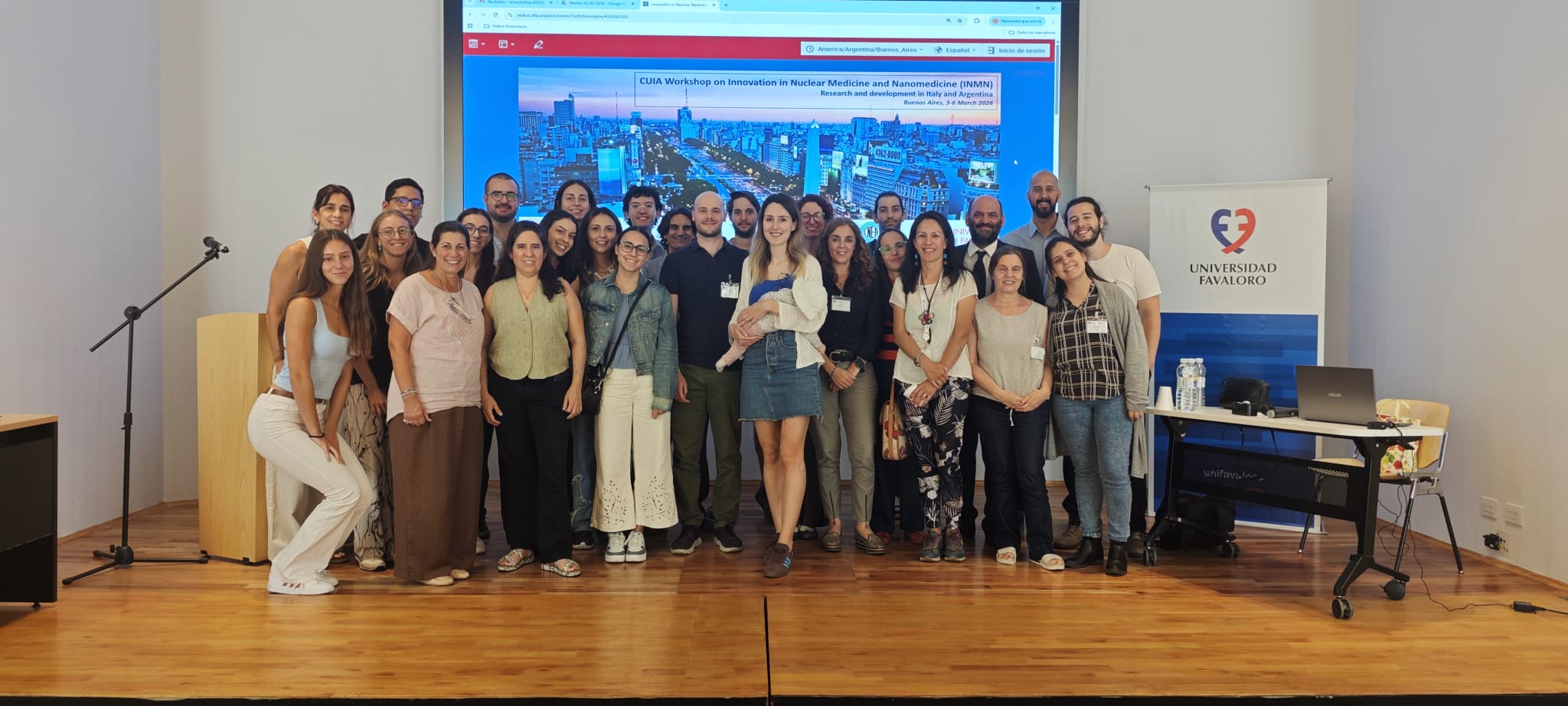
Thank you for joining INMN 2026! The event was a resounding success, bringing together a vibrant community of experts. We were thrilled to host over 70 attendees in person, with our reach extending to 110 participants when including those who joined us remotely. This level of engagement truly highlights the importance of our shared goals.
At present, we are witnessing the emergence of a scientific and technological development platform capable of offering radioisotope-based therapies and diagnostic methods new opportunities for the creation of innovative tools and, consequently, for the introduction of new production and clinical application modalities, with the profound social impact that this entails. However, the link between scientific-technological innovations and their translation into the clinical domain is not straightforward and requires a preclinical and pre-commercial context supported by strong and long-term collaborations among groups able to integrate and strengthen their respective expertise and resources.
Such themes are of great strategical importance in two countries like Italy and Argentina, where the study and development of medical applications of nuclear physics and radiochemistry have been traditionally relevant topics among several universities and institutes. For this reason, the Italian University Consortium for Argentina (CUIA) decided to include this event in the rich program of the CUIA Days in Argentina 2026, with the aim of creating new Italian-Argentine connections to enhance the research opportunities in these fields.
Within this framework, the INMN 2026 workshop is based on the following key points:
- new possibilities for radioisotope production;
- nanomedicine technologies for highly selective delivery;
- understanding the impact of new high-selectivity methodologies and their heterogeneity on radiation dose distributions and the resulting radiobiological effects;
- the training of researchers and technologists capable of addressing these challenges.
The event has two official languages: English and Spanish. For more information, take a look to our scientific program!
¡Gracias por haber participado a INMN 2026! El evento fue un éxito rotundo, logrando reunir a una comunidad de expertos muy activa. Estamos muy contentos de haber recibido a más de 70 asistentes presenciales, llegando a un alcance de 110 participantes sumando a quienes se conectaron de forma remota. Este nivel de compromiso resalta realmente la importancia de nuestros objetivos compartidos.
Actualmente, asistimos al surgimiento de una plataforma de desarrollo científico y tecnológico capaz de ofrecer terapias y métodos de diagnóstico basados en radioisótopos, nuevas oportunidades para la creación de herramientas innovadoras y, en consecuencia, para la introducción de nuevas modalidades de producción y aplicación clínica, con el profundo impacto social que ello conlleva. Sin embargo, la conexión entre las innovaciones científico-tecnológicas y su aplicación en el ámbito clínico no es sencilla y requiere un contexto preclínico y precomercial respaldado por colaboraciones sólidas y a largo plazo entre grupos capaces de integrar y fortalecer sus respectivas experiencias y recursos.
Estos temas son de gran importancia estratégica en dos países como Italia y Argentina, donde el estudio y el desarrollo de aplicaciones médicas de la física nuclear y la radioquímica han sido tradicionalmente relevantes para diversas universidades e institutos. Por esta razón, el Consorcio Universitario Italiano para Argentina (CUIA) decidió incluir este evento en el amplio programa de las Jornadas del CUIA en Argentina 2026, con el objetivo de crear nuevas conexiones ítalo-argentinas para potenciar las oportunidades de investigación en estos campos.
En este marco, el taller INMN 2026 se centra en los siguientes puntos clave:
- nuevas posibilidades para la producción de radioisótopos;
- tecnologías de nanomedicina para una administración altamente selectiva;
- comprender el impacto de las nuevas metodologías de alta selectividad y su heterogeneidad en la distribución de dosis de radiación y los efectos radiobiológicos resultantes;
- la formación de investigadores y tecnólogos capaces de abordar estos desafíos.
El evento se imparte en dos idiomas oficiales: inglés y español. Para más información, ¡consulte nuestro programa científico!